All Blog Tags
Found: A Box Full of Family History – These Photos Have Been Waiting Long Enough
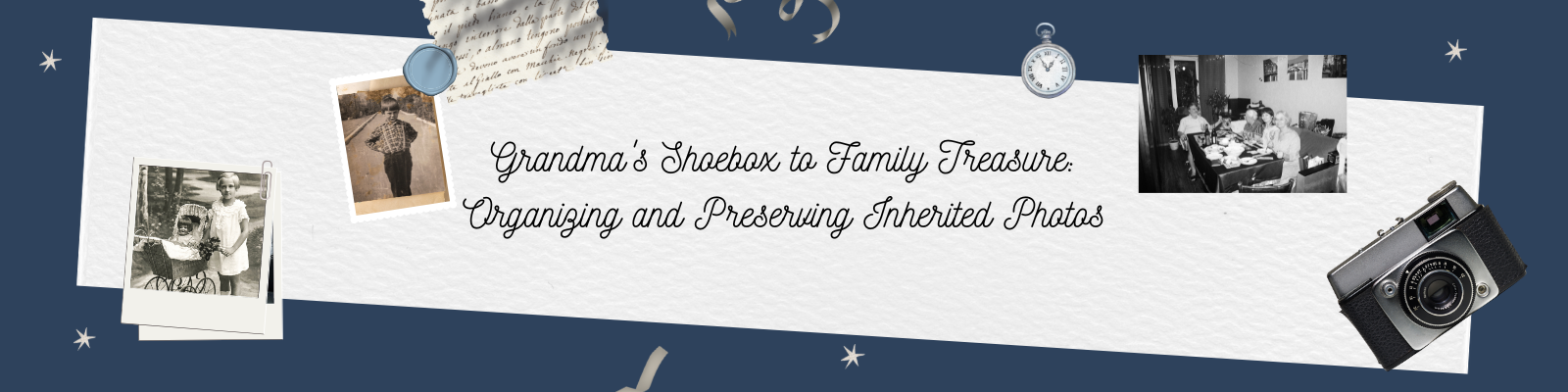
You open a box in the closet, a drawer, or an old storage bin - the box is filled with photographs so you start flipping through them and suddenly time collapses. Faces you remember, faces you don’t. Old family photos you’ve never seen before. Places that no longer exist. Moments that feel both intimate and distant at once.
And then comes the other feeling: what do I do with all of this?
Inheriting family photos means inheriting responsibility — and for most people, a quiet sense of overwhelm. You want to do right by these memories. You just don't know where to start. If that's where you are, you're not alone — and there's a clear path forward.
Why Inherited Photos Are Worth Preserving
It is easy to underestimate what you are holding when everything is scattered and disorganized. But family photographs are more than keepsakes. They are primary records of lives lived. They capture details that no written record ever could: the way someone stood, the clothes they wore, the expressions they made when they thought no one was paying attention.
In many cases, these images are the only remaining connection to people, homes, and traditions that no longer exist. Once they are lost or damaged beyond repair, there is no getting them back.
The good news is that even photos that look worn, faded, or chaotic are often more salvageable than they appear. A bent corner, a bit of fading, or a dusty surface does not mean the image is gone. It just means it needs care.
Organizing photos is not just a task – it becomes a process of rediscovery. As you sort through them, patterns emerge. Stories start to connect. You begin to see not just individual images, but a larger narrative of your family’s story slowly coming back into focus.
What's Actually in That Box: How to Organize Inherited Photos by Format
Most inherited photo collections fall into a few familiar categories.
There are the classic shoeboxes loose prints stacked together, sometimes spanning decades. You might find old albums with sticky pages, where photos are trapped under plastic that is now clouding or peeling. There may be envelopes from photo labs, filled with duplicates and negatives. And often, there are slides or strips of film that you cannot even view without special equipment.
It can feel like a mess, but it is a very normal kind of mess.
Before you begin, it helps to reset expectations. You are not aiming for perfection. You are aiming for accessibility. A collection that is loosely organized, labeled where possible, and safely stored is already a huge step forward.
One simple but important habit to adopt right away is to handle photos with clean, dry hands. Oils from your skin can cause long term damage, especially to older prints. If you want to be extra careful, cotton gloves are a good option, but clean hands are usually sufficient for most collections.
How to Sort Old Family Photos Without Losing Your Mind
The biggest mistake people make is trying to organize everything perfectly from the start. That is a fast track to frustration.
Instead, start by grouping photos into rough eras or decades. You don't need exact dates — broad categories like 1940s–50s, 1970s, or early 2000s are enough to get started. Visual clues will help more than you might expect, and once you know what to look for, dating a photo becomes surprisingly intuitive.
The print itself is often your first clue. White borders with rounded corners typically point to the 1950s and 60s. Scalloped or deckled edges are a hallmark of the 1970s. Borderless prints became standard from the 1980s onward, and if you find a matte-finish 4x6 with a date stamp on the back, you're almost certainly looking at 1990s drugstore processing.
Colour can also tell you a lot. Photos with a warm yellow-orange cast are often Kodachrome, which dates them to the pre-1980s era. A washed-out, faded palette is common in 1970s colour negative film as it ages, while vivid, slightly oversaturated prints are more characteristic of 1980s and 90s consumer film.
Clothing and hairstyles are the most familiar dating tools but go beyond the general. Wide lapels and bell bottoms anchor a photo in the 1970s. Shoulder pads and perms place it firmly in the 1980s. Eyeglass frame shapes, tie widths, and even car models visible in the background can all help narrow things down. And if you come across small square prints, those are likely from an Instamatic or early Polaroid camera — a format popular through the 1960s and 70s.
Once you have created these broad groups, you can gradually narrow things down by event, by family branch, or by location but only if it feels useful.
As you sort, you will come across duplicates, blurry shots, and photos where no one is identifiable. It is okay to set those aside. You are not erasing history. You are making space for what matters most. When you are ready to label photos, use a pencil not a pen or marker. Ink can bleed through over time and damage the image. A Post-It note on the back with names, approximate dates, or locations is enough.
It is also helpful to separate by format early on. Prints, slides, negatives, and digital files all require different kinds of care. Keeping them grouped makes the next steps much easier.
Putting Names to Faces: Preserve the Stories Behind Old Family Photos Now
The knowledge of who is in these photos and what was happening when they were taken often lives in people, not in the images themselves. And over time, that knowledge can fade or disappear.
If you have access to older relatives, this is the moment to involve them. It does not have to be formal. You can sit together at a table, flip through photos, and jot down notes as memories surface. Or, if distance is a factor, a simple video call works just as well as holding photos up to the camera and asking questions.
You might be surprised by how much comes back with just a little prompting. This step is less about accuracy and more about preservation. You are capturing context before it disappears and that context is what turns a photo into a story.
How to Store Old Photos So They Actually Last
Once your photos are sorted and partially identified, the next priority is keeping them safe.
For physical prints, photo preservation starts with protecting them from the three main threats: light, heat, and humidity. Archival quality materials make a big difference here. Acid free sleeves, envelopes, and storage boxes help prevent deterioration over time.
Try to store photos in a cool, dry place not in attics, basements, or garages where temperature and moisture fluctuate.
If you are dealing with old adhesive albums (also called magnetic albums), it is worth addressing them sooner rather than later. These older adhesive albums can actively damage photos, causing them to discolour or adhere to the adhesive page permanently. Removing prints requires patience. Work slowly, and do not force anything. If a photo resists, it is better to pause than risk tearing it.
For prints that have already sustained significant damage — discolouration, tearing, or stubborn adhesive residue — Annex Photo’s professional photo restoration can recover detail that looks lost. It's worth exploring before assuming a photo is beyond saving.
At this stage, you might also start thinking about digitization not as an extra task, but as a natural extension of what you have already done.
How to Digitize Old Family Photos: Choosing the Right Approach
Digitizing your collection is one of the most effective ways to preserve and share it. A digital copy protects the image from physical loss and makes it easy to distribute among family members.
There are a few ways to approach this, depending on your time, tools, and the size of your collection.
If you prefer a hands-on approach, a flatbed scanner that is designed to scan photos and negatives is a solid option for printed photos. It offers good control over quality and works well for standard sizes. Resolution often measured in DPI determines how much detail is captured. Higher resolution is generally better, especially for smaller originals that you might want to enlarge later.
Smartphone scanning apps are another option. They are quick and convenient, and they can produce surprisingly good results for casual sharing. However, they are not always ideal for long term preservation, especially if image quality is a priority.
For larger collections, fragile originals, or anything that includes slides and negatives, professional scanning is the right call. Annex Photo's photo scanning services are built for exactly this kind of project — high-resolution results, careful handling of delicate originals, and the ability to work across formats including prints, slides, negatives, and old home video.
As you create digital files, think about simple naming conventions, something like 1970s Family Reunion 01 is far more useful than a default file name. A little consistency now will save a lot of time later.
From Shoebox to Photographic Treasure: What You Can Do Once It's Organized
At a certain point, something shifts. The photos are no longer just a project. They start to feel like a collection again. Coherent. Meaningful. Alive.
And that is where the real reward begins.
Once your photos are organized and digitized, you can actually use them. You might create a photo book that tells a family story from one generation to the next. You could make reprints so siblings or cousins each have their own copies. A few carefully chosen images can be framed and displayed, turning forgotten moments into part of everyday life.
Even something as simple as a digital slideshow at a family gathering can reconnect people to their shared history in a powerful way.
This is also where the effort you have put into labeling and organizing pays off. Names, dates, and context transform a collection of images into something that can be understood and appreciated by future generations.
You are no longer just preserving photos. You are creating access to memory.
These Photos Deserve More Than a Box
The box has been waiting long enough — and so have the people in it.
You don't have to do this all at once. Sort a handful of photos. Label what you can. Scan a few that matter most. Every small step moves a memory out of a storage bin and into the world where it belongs.
When you're ready to take the next step — whether that's scanning a shoebox, restoring a damaged print, or turning a collection into a photo book — Annex Photo is here to help. Explore our scanning and preservation services.
Frequently Asked Questions
Q: What is the best way to organize inherited photos?
Start by sorting into broad decades or eras rather than trying to achieve perfect chronological order. Separate by format — prints, slides, and negatives all need different handling. Label in pencil on the back where possible, and involve older relatives early to capture names and context before that knowledge is lost.
Q: How do I find out when old family photos were taken?
The print itself offers strong clues — border styles, paper finish, and print size can help narrow down the decade. Clothing, hairstyles, eyeglass frames, and cars in the background are also reliable visual dating tools. Colour cast can help too: warm yellow-orange tones often indicate Kodachrome film from the pre-1980s era.
Q: What is the best way to digitize old family photos?
It depends on the size and condition of your collection. A flatbed scanner works well for standard prints. Smartphone scanning apps are convenient for casual sharing but less reliable for archival quality. For large collections, slides, negatives, or fragile originals, professional scanning services produce the most consistent, high-quality results.
Q: How should I store old photographs to prevent damage?
Keep prints in acid-free sleeves or archival boxes, away from heat, humidity, and direct light. Avoid attics, basements, and garages where conditions fluctuate. If photos are stored in old adhesive albums, consider removing them — these albums can actively damage prints over time.
Q: Can damaged or faded family photos be restored?
In many cases, yes. Faded, torn, or discoloured photos can often be digitally restored to recover significant detail. Professional photo restoration services are worth exploring before assuming a photo is beyond saving.
Share
Most Recent Posts