All Blog Tags

They're Both 'Film' — But That's Where the Similarities End
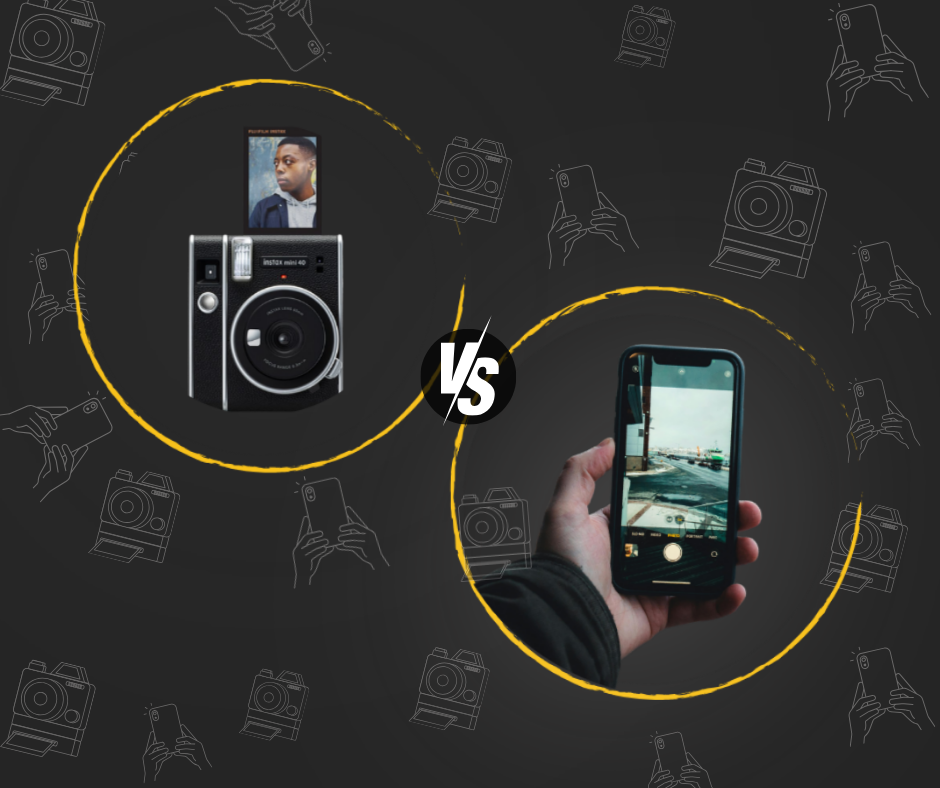
If you walk into a camera shop and ask for "film," you are going to get a follow-up question. "Instant, or traditional?"
A lot of people assume the two terms are interchangeable. They are not. While both types rely on light-sensitive chemistry, one develops itself in your hand and the other doesn't show you anything until it's processed. They require different workflows, cost different amounts per frame, and yield vastly different physical results. This is not a debate over which format is objectively better. Traditional film is not the "serious" choice, and instant film is not just a party trick. Here is the actual breakdown of how they work, what they cost, and how to figure out which one belongs in your bag.
How Each One Actually Works
The most fundamental difference between instant and traditional film comes down to what happens after you press the shutter. Everything else builds on this single mechanical divide.
Instant film develops itself. The chemistry is entirely self-contained inside the film sheet or pack. When you take a photo with a camera like an Instax Mini 13 or a Polaroid Now, internal rollers burst a chemical pod as the film ejects. Within a few minutes, the image develops right in your hand. There is no darkroom, no chemical bath, and no lab drop-off. What comes out of the slot is the final product.
Traditional film requires development. When you shoot standard 35mm film or medium format 120 film, nothing happens inside the camera except exposure. The image is captured as a latent, invisible impression on the film strip. To see it, you have to extract the film, prep it, and develop it using liquid chemistry. Once developed, the negatives must be scanned into a computer or optically printed with an enlarger to become viewable photos.
Where Hybrid Cameras Fit In
Technology has blurred the line between analog and digital, and a few cameras now sit squarely in the middle. Cameras like the Fujifilm Instax Mini Evo or the Instax LiPlay use a digital sensor to capture the image, display it on an LCD screen, and let you apply digital filters before you print. Once you like what you see, you send the digital file to a built-in printer that exposes it onto physical Instax film.
Other modern instant cameras feature Bluetooth app pairing, allowing you to select photos from your smartphone gallery and print them out on instant film on demand. Treat these as a separate category of convenience rather than a third core film format. They are great if you want the tactile feel of an instant print without wasting expensive film chemistry on a missed focus or a bad exposure. But if you want a pure optical experience, you are looking at either a purely mechanical instant camera or a traditional film camera.
Image Quality and Detail
If you measure everything by sharpness, resolution, and dynamic range, traditional film is the clear winner.
A 35mm negative already holds more visual information than an Instax print ever will, and medium format 120 pushes that gap even wider A standard roll of 35mm film holds an enormous amount of visual information, and medium format 120 film scales that up significantly. Within each frame, you have plenty of room to push exposures, recover shadow detail, and make large-format prints.
That gap comes down to design, not neglect — the chemistry has to be thin enough to fit in a portable sheet, which caps how much fine detail it can hold. Furthermore, what you shoot is locked in. If an instant photo is underexposed, you cannot dig shadow detail out of a raw file or a high-res scan later. You get what the chemistry gives you on the spot.
Control Over the Final Look
Your level of creative control depends entirely on when you want to make your decisions. With traditional film, control happens at every stage of the process. You choose a specific film stock like Kodak Ektacolor Pro 400 or Ilford HP5 Plus for its specific colour profile or grain structure. You can push or pull your ISO during shooting and development to alter contrast and shadow retention, and you make more choices when scanning or printing in the darkroom.
With instant film, creative control happens entirely at the point of shooting. You cannot change how the chemistry develops, and you cannot rescue a bad scan later. Your choices are locked to framing, lighting your subject, and picking the right instant film variant, such as Instax Wide for landscapes or Polaroid's colour versus black-and-white chemistry.
Cost Per Shot
Film photography is an investment, but the two formats structure that investment differently. Instant film has a predictable, immediate entry cost. Fujifilm Instax Mini film generally runs around $1.15 to $1.30 per frame, while Polaroid colour film runs closer to $3.50 to $4.00 per frame. Every single click of the shutter costs real money immediately. If you mess up, you throw away a couple of dollars.
Traditional film looks cheaper on paper until you add processing. A roll of 35mm film with 36 exposures costs around $12 to $20 CAD, which breaks down to roughly $0.35 to $0.55 per frame for the raw stock. However, lab development and scanning typically add another $18 to $25 CAD per roll.
While traditional film is cheaper per frame if you shoot a full roll of 36 exposures, it requires a larger upfront commitment. With instant film, you buy a 10-pack of Instax and spend about $14 CAD total – nothing more to pay. With traditional film, the roll itself is one cost, and developing it is a separate one, which is how that $35 to $45 CAD total adds up before you ever see your shots.
The Experience Itself
The biggest differentiator between the two formats isn't technical - it's experiential. Nothing about a spec sheet explains what it feels like to hand someone a print that's still developing in their hands.
Hand someone a print that's still developing and you've got their full attention — that's instant film's whole appeal at a party, a wedding, or a weekend hang. The primary joy of instant film is handing a physical, developing piece of film to someone else while they watch the image appear. It prioritizes the moment over technical perfection.
With only 24 or 36 exposures on a roll, traditional film forces you to think before you press the shutter — check the light meter, focus manually, then wait days to find out if it paid off You check your light meter, you focus manually, and then you wait days or weeks to see if your vision paid off. It is an independent, reflective process.
Which One Should You Actually Pick?
Choose Instant Film if:
- You want physical photos to hand out at parties, events, or trips immediately.
- You love scrapbooking, journaling, or pinning physical prints to your wall.
- You want a low-friction, zero-lab experience where what you see is what you get.
Choose Traditional Film if:
- You want to learn exposure fundamentals, mechanical camera operation, or darkroom printing.
- You care about high-resolution image quality, wide dynamic range, and crisp detail.
- You want to build a cohesive body of work or a portfolio over a series of rolls.
Ready to Shoot?
Most photographers who stick with film eventually end up using both. An instant camera lives in a bag for weekend trips and social gatherings, while a 35mm or medium format camera comes out for dedicated photo walks and projects. Most people don't pick one over the other so much as they figure out which one fits the day they're having.
Stop by Annex Photo or browse our inventory online to check out our current stock of 35mm rolls, medium format stocks, Instax cameras, and instant film packs. If you aren't sure which one fits your next project, come in and talk to us and we'll help you sort it out.
Share
Most Recent Posts